About the workshop
Europe must plan grids, industry and energy supply for decades ahead without knowing future fuel prices, technology costs or how fast new infrastructure gets built. RESILIENT has developed open-source tools and methods to address this uncertainty. We applied them in research papers and case studies, taught them in workshops and training events, and contributed them to the open-source PyPSA ecosystem.
At this final workshop, we share what we have learned: the project's main findings, case studies from Germany, Finland and France, and the open data and tools anyone can reuse. A panel weighs the costs and benefits of reducing Europe's dependence on gas imports.
Programme
-
Arrival, coffee and croissants
-
Welcome: why RESILIENT, why now?
Tom Brown, TU Berlin
-
RESILIENT: what we have built and what we have learned
Iegor Riepin, TU Berlin
Project summary, main findings and reusable outputs.
-
Research I: European energy planning under uncertainty
-
Diversity of biomass usage pathways to achieve emissions targets in the European energy system
Markus Millinger, RISE · Nature Energy, 2025
-
The role of Projects of Common Interest in reaching Europe's energy policy targets
Bobby Xiong, TU Berlin · Environmental Research Letters, 2026
-
Accelerating fossil gas independence in Europe
Lukas Franken, TU Berlin · arXiv, 2026
-
Diversity of biomass usage pathways to achieve emissions targets in the European energy system
-
Panel: Less gas, less risk? Energy independence and the price of resilience
Bringing together research, policy and grid-planning perspectives, this panel discusses the costs and benefits of reducing Europe's gas-import dependence. What is the price of greater independence, and how should it be weighed against exposure to future gas-price shocks? What would it take to electrify industrial heat, and how can grids, flexibility and backup capacity support that transition? Could gas still shape electricity prices even as consumption falls? And who should bear the costs? Audience questions welcome.
-
Coffee and networking
-
Case studies: industry, carbon and e-fuels
Four case studies from RESILIENT partners.
-
Case study North Rhine-Westphalia
IN4climate.NRW, Fraunhofer ISI and TU Berlin · NRW workshop slides, 2026
-
Case study Baden-Württemberg
TransnetBW · CEMENT, 2026
-
Case study Finland
LUT
-
Case study France
EDF
-
Case study North Rhine-Westphalia
-
Coffee and networking
-
Research II: from results to reuse: open tools, data and faster optimisation
-
Modelling the high-voltage grid using open data for Europe and beyond
Bobby Xiong, TU Berlin · Nature Scientific Data, 2025
Plus a preview of ongoing grid-builder work. -
PyPSA and SMS++: decomposition, benchmarks and how to use the tool
University of Pisa · Deliverable D2.1, 2026
-
Co-optimising steel transformation and the European energy system: An age- and site-resolved representation of iron and steel in PyPSA-Eur
Khaled Al-Dabbas, Fraunhofer ISI · SSRN, 2026
-
Modelling the high-voltage grid using open data for Europe and beyond
-
What comes next? Takeaways and closing
Tom Brown and Iegor Riepin, TU Berlin
Project takeaways, access to outputs, next collaboration opportunities and thanks.
-
Snacks, open end Q&A, networking
Venue
Fraunhofer ENIQ
EUREF-Campus 23-24
10829 Berlin
About 10 minutes on foot from Berlin Südkreuz station (exit Hildegard-Knef-Platz).
Registration
Please register in advance. Places are limited.
Register nowOrganisers
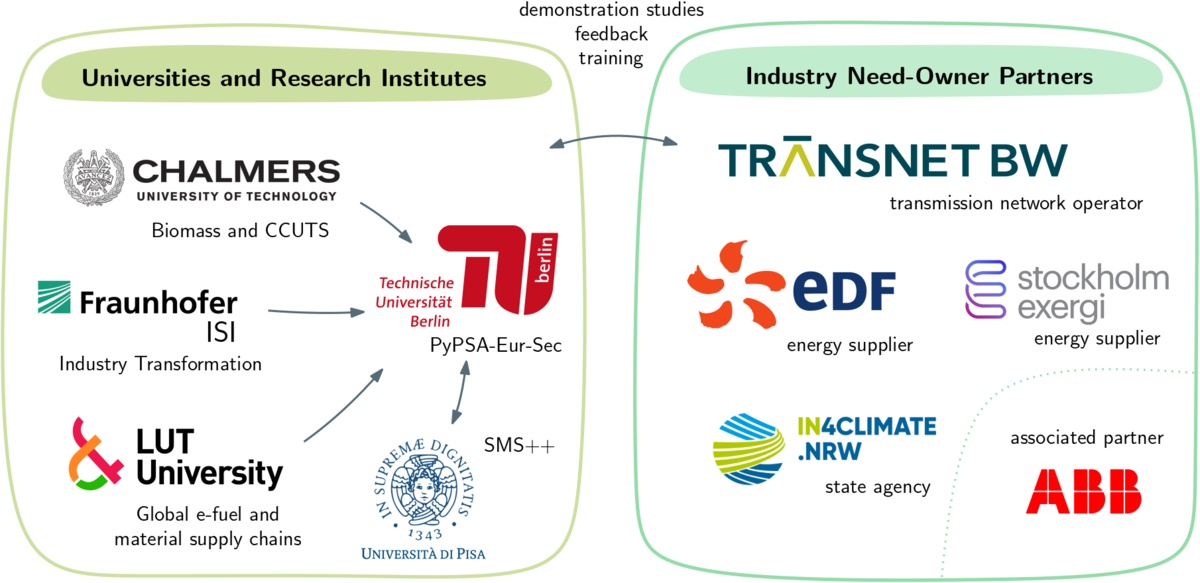
The workshop is organised by TU Berlin, Fraunhofer ISI and IN4climate.NRW. RESILIENT brings together universities, research institutes and industry partners from five countries and is funded through the Clean Energy Transition Partnership 2022 programme, with the German partners funded by the Federal Ministry for Economic Affairs and Energy (BMWE).
Questions? Write to ed.nilreb-ut - ta - nipeir.rogei